When you purchase through the links on my site, you support the site at no extra cost to you. Here is how it works.
If you’ve ever opened a mixing tutorial and immediately gotten lost at the word “compression,” you’re not alone. I think compression is one of those topics that sounds more complicated than it actually is once you break it down into plain language.
In this guide, I’ll walk through what a compressor actually does, why it matters, and then get into the three classic compressor types you’ll run into: VCA, FET, and Vari-Mu. I’ll use three real plugins from Pulsar Audio as reference points along the way: Pulsar 1178 (FET), Pulsar VM-Comp (Vari-Mu), and Pulsar IPA 25 (VCA).
What a Compressor Actually Does
Sound moves through space as a wave, a force that disturbs the air around it in a repeating pattern. This is why a DAW displays audio as a wavy shape. It closely matches how sound actually behaves, unlike a flat line.
This wave shape is called the envelope, and the distance between its highest and lowest points is the dynamic range. A compressor’s entire job is to reduce that dynamic range, meaning it makes the loud parts of a signal quieter while leaving the quiet parts alone, which in turn reshapes the envelope itself.
It works automatically. The compressor listens to the signal and, whenever it exceeds a set volume level, reduces that part of the signal according to settings you control.
Think about a vocalist who sings some words softly and then belts out others. Without processing, loud moments jump out in a mix. The quiet parts get buried under everything else.
Compression solves that problem and, somewhat counterintuitively, offers a few other benefits.
- It makes the track louder overall. By taming the loudest peaks first, you create headroom to raise the average volume of the entire signal without clipping.
- Compression helps instruments and vocals remain present in a mix, ensuring quieter details are audible alongside louder passages.
- It adds cohesion. Compression on a mix bus or master glues separate elements together. This makes them feel like one recording, not just a pile of individual tracks.
- When pushed, compression becomes a creative effect, adding punch, movement, or unique character to the sound.
I always tell people to think of the four main controls as a team, not separate switches. They work together. Once you understand each one, compression stops feeling mysterious.
- Threshold
The volume level at which the compressor starts working. Once the signal crosses it, gain reduction kicks in, and anything that stays below simply passes through completely untouched. Get this wrong and nothing else you do really matters, since it’s the gate that decides whether compression happens at all.
- Ratio
Think of this as the compressor’s strength dial once the signal crosses the threshold. A 4:1 ratio means that for every 4 dB the signal goes over the threshold, only 1 dB comes through, and I find it helps to picture it as a math problem rather than an abstract sound concept. Higher ratios feel more aggressive, lower ratios feel gentler.
- Attack
It’s how quickly the compressor reacts once the threshold is crossed. Fast settings catch transients almost instantly and can tame sharp peaks before they cause trouble, while slower settings let the initial punch of a sound through before compression takes over. I usually treat attack as the control that shapes personality more than anything else on this list.
- Release
Once the signal drops back below the threshold, this control decides how quickly the compressor lets go and stops working. Short release times create a pumping effect that’s genuinely audible, sometimes in a good way, and longer release times smooth everything out so gently you barely notice it working. This one takes the most ear training to dial in by feel.
Why Compression Matters in a Mix?
Compression isn’t just a technical fix; it’s genuinely one of the tools that gives a mix its character. Used subtly, it can glue elements of a mix together so they feel like one cohesive thing rather than a collection of separate tracks.
More aggressive compression adds punch, aggression, or even distortion-like color. That’s part of why different compressor circuits sound so different, even if they’re all reducing dynamic range.
The differences among the three classic compressor types stem from their unique internal gain-reduction methods, which influence the tone and feel of compression.
FET Compressors: Fast and Characterful
These compressors are known for their quick response, making them highly effective at catching transients. FET compressors uses Field-Effect Transistors as the core of their fast-acting gain-reduction system.
One detail that surprises many beginners is that most FET compressors don’t actually have a threshold knob. Instead, the compression amount is controlled by the input gain, since the threshold is fixed internally. You drive more signal in, and you get more compression as a result.
Pulsar 1178 is a good real-world example of this category. It’s modeled on the Urei 1178, a stereo version of the well-known 1176, and it’s been used by mixers like Chris Lord-Alge and Bob Clearmountain.
Its attack and release controls span a genuinely fast range, with attack times from around 800 microseconds down to 20 microseconds, and it includes the famous “all-buttons-in” mode that pushes the compressor into a more aggressive, characterful limiting behavior.
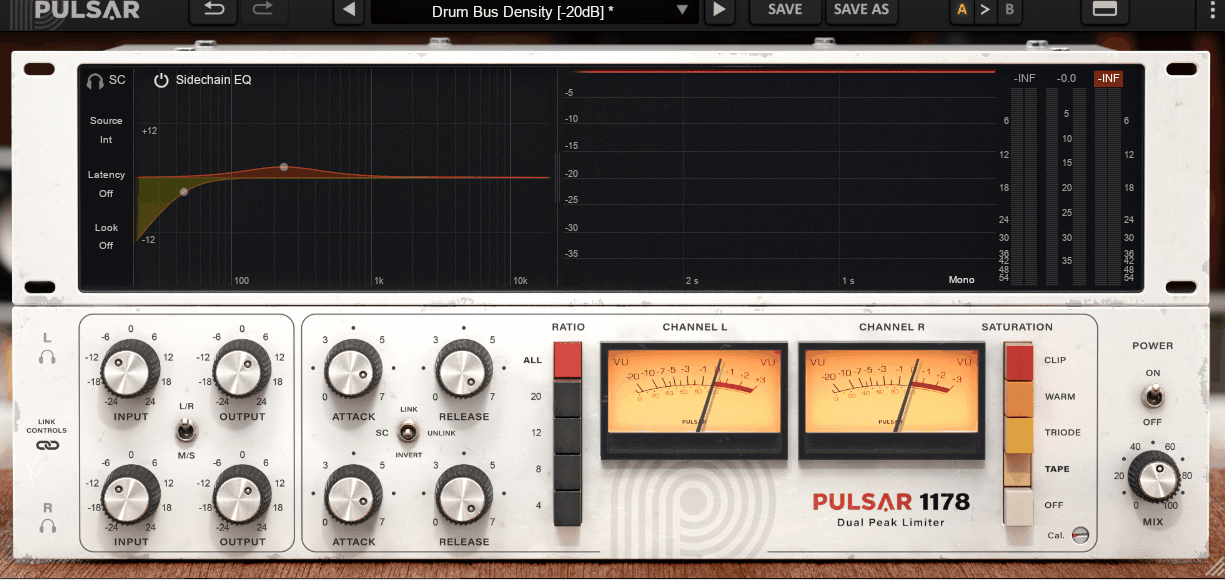
FET compressors like this one tend to shine on vocals, drum overheads, bass, and acoustic guitar, anywhere you want speed and a bit of aggressive character rather than something ultra-transparent.
Pulsar 1178 also adds a four-band sidechain EQ and four flavors of saturation, which go beyond what the original hardware offered while staying true to the FET character at its core.
Before FET compression:
After FET compression:
Vari-Mu Compressors: Slow, Musical, and Full
Vari-mu compressors use variable tube biasing for gain reduction, creating musical, program-dependent compression that adapts to the audio material.
This results in a noticeably slower attack compared to FET- or VCA-based compressors, but the trade-off is an extremely musical, smooth quality that’s hard to replicate with faster circuit types. It’s also why vari-mu compressors are such a common choice for mastering and bus compression, where the goal is often cohesion rather than aggressive control.
Pulsar VM-Comp is built specifically around this behavior. It reproduces the gentle, program-dependent compression that vari-mu hardware is known for, and its attack and release ranges reflect that character, with attack running from about 2 to 100 milliseconds and release from 70 milliseconds up to 1.8 seconds.
There’s also a HI RATIO switch that toggles between a light 1.5:1 ratio and a heavier 4:1 limiting mode.
I think the real appeal of vari-mu compression only clicks once you’ve heard it working on the right material, so here’s where it tends to earn its keep in an actual session.
- Mix buses
The most classic vari-mu use case there is. A slow attack and moderate release lets the compressor react to the overall shape of the mix rather than individual transients, which is exactly what creates that sense of glue people talk about so much.
- Mastering chains
Vari-mu compression can act as a gentle leveler, a glue compressor, or even a limiter, depending on how attack and release are set. That flexibility is honestly what makes one plugin useful across such different mastering approaches.
- Drum buses
Even on faster material like drums, a vari-mu compressor can restore a sense of room ambience and cohesion, particularly with more noticeable gain reduction or a parallel compression setup layered underneath.
- Vocals
Program-dependent behavior means the compression follows the natural dynamics of a performance instead of imposing a rigid threshold. That’s exactly why vari-mu compressors keep showing up on lead vocal chains decade after decade.
Before Vari-Mu/Opto compression:
After Vari-Mu/Opto compression:
FET
VCA Compressors: Precise and Punchy
VCA stands for Voltage-Controlled Amplifier, and this compressor type is generally known for being precise, fast, and controllable, without necessarily adding as much obvious harmonic color as FET- or vari-mu-based designs. VCA compressors became a studio standard because they offer a strong balance of punch and accuracy, especially on buses and groups.
Pulsar IPA 25 is a modern take on this category, and it’s a good example of how far VCA compressor plugins have come. Rather than modeling a single fixed circuit, it lets you switch between four gain-reduction modes, each altering the harmonic character of the compression while the underlying detector and timing remain the same.
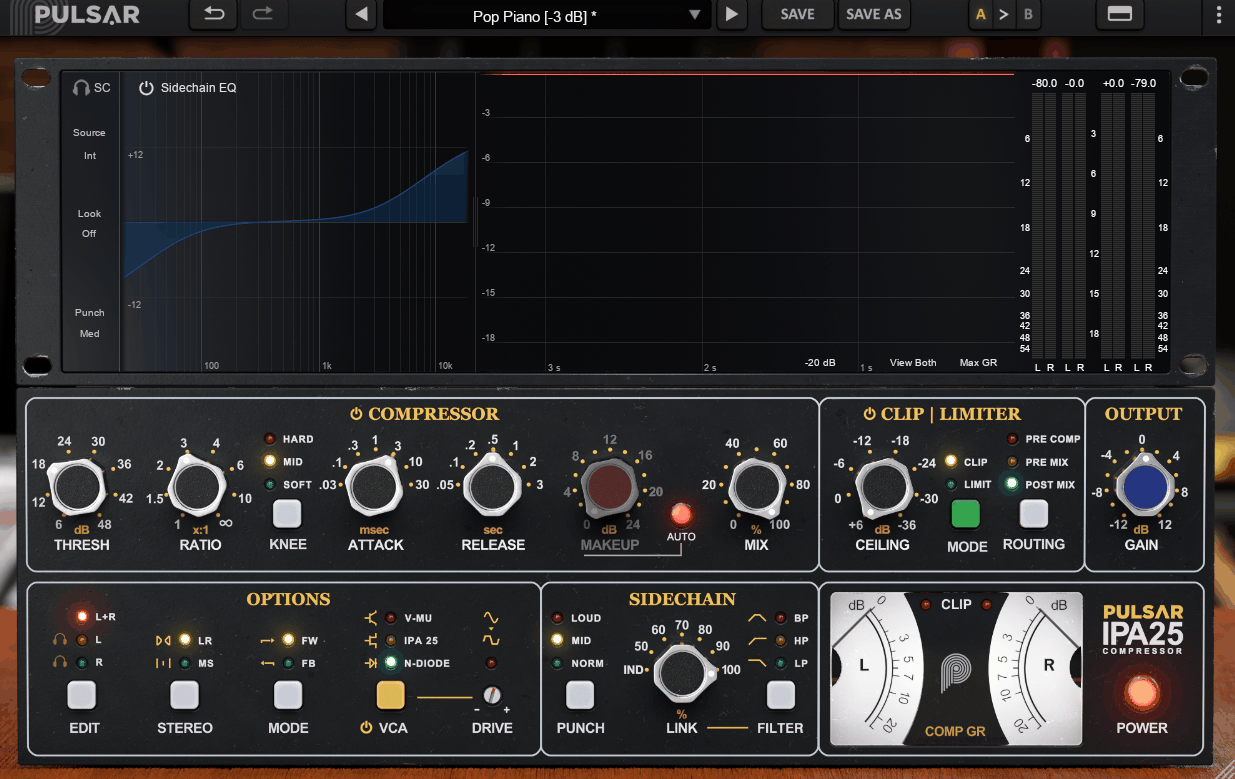
What I like about this approach is that you’re not locked into one personality the way older hardware forces you to be. Here’s what each of those four modes actually gives you:
- Clean VCA
No circuit coloration here, just pure envelope control, giving you gain reduction without the plugin adding its own tonal fingerprint on top. It’s the setting I reach for when I want the compression itself to stay invisible.
- Original Hardware VCA
Modeled after the original circuit’s behavior, this one keeps things tight and controlled at moderate settings, then introduces a touch of harmonic thickness as you drive it harder. The character only really shows up when you ask for it.
- V-Mu
Tube-style compression is the inspiration behind this one, rounding off the sharper edges of transients and adding a low-mid warmth that feels closer to vari-mu behavior than a typical VCA circuit. It’s a shortcut to that vibe without switching plugins.
- N-Diode
Built around a diode-bridge circuit, this mode leans into grit, with an uneven clipping pattern that pushes the midrange forward more than in the other three modes. I treat it as the option for when a track needs some extra edge rather than transparency.
Its attack range spans roughly 30 microseconds to 30 milliseconds, and release runs from about 50 milliseconds to 3 seconds, giving it a genuinely wide range for both fast, punchy work and slower, more sustained compression. It also includes a Punch selector with Norm, Mid, and Loud settings that shift the sidechain detector’s focus across the frequency spectrum, along with an integrated clipper/limiter section that can be routed before or after the compression stage.
VCA compressors of this style are commonly used on drum buses, mix buses, and mastering chains, where you want reliable, controllable dynamics with the option to dial in more character when needed.
Before VCA compression:
After VCA compression:
When should I use compression?
You shouldn’t simply go around applying compression willy-nilly. When you use it, you should know why you’re doing so and what you’re trying to achieve.
- To tidy up live performances
When people are playing live there are often inconsistencies. Singers can vary in volume, or a guitar can drop in and out excessively in certain places. Compression allows you to even things out and boost what’s getting lost.
- To add ‘punch’ and/or texture
By playing around with the attack and release settings you can work wonders with say, a drum sound. For example, a slow attack on a kick drum can make it sound punchier. A fast release brings forward the quiet end of a sound, adding texture, while a slow release smooths things out.
- To increase cohesion
Compression can help you unite the sound of multiple tracks by adding some compression to all of them via a single bus. This is a delicate, subtle job so don’t be heavy handed. The goal is to make things sound unified.
- To draw attention to the small stuff
You can use compression to bring out what might otherwise get missed and lost in the mix. That might be the ‘extra’ details from a live recording, such as fingers striking wood or strings, or the subtle and atmospheric background texture of a room.
When should I NOT use compression?
- For virtual instruments
Many of these digital instruments are already tightly processed. People who make digital instruments and many synthesiser plugins have often programmed them to a fine degree of detail.
These sounds already been compressed, so adding more compression on top can ruin the sound the creator has worked so hard to programme.
- For genres that rely on dynamism
Jazz, ambient, classical – genres where big differences between quiet and loud are frequent and important for imparting emotion don’t benefit as much from compression.
Think of piece of classical music where there is a quieter, solo part from a single instrument like a violin or a flute, followed by the whole orchestra crashing in at once in a dramatic flourish.
That huge contrast between quiet delicacy and a bold orchestral statement is used by composers to impart complex emotion. Heavy-handed use of compression in such a recording might flatten out that contrast or bring to the fore background noise during the solo part and that would be criminal.
- For fixing broken things
If a recording is just bad and highly unbalanced, a compressor can’t really save you, sadly. It’s just as important as ever that sound engineers learn the foundational skills of how to set up microphones and capture good quality recordings that are as balanced as possible and free from interference.
Then, compression can be used to finesse and further improve upon those good recordings. No matter how amazing a building is, if its foundations are crumbly or it’s built on a swamp it will come tumbling down.
Putting the Three Types Side by Side
If you’re trying to build a mental map of these three types, here’s a simple way to think about it. FET compressors, like the Pulsar 1178, react the fastest and add aggressive character, making them a strong choice when you want a sound to feel punchy or larger-than-life.
Vari-mu compressors, like Pulsar VM-Comp, react the slowest and add smooth, musical glue, which is why they’re a mastering and bus compression staple rather than something you’d reach for on a snappy transient. VCA compressors, like Pulsar IPA 25, sit in between, offering speed and precision with flexible character options, which is part of why VCA designs have become such a common all-purpose choice in modern studios.
None of these types is objectively better than the others. They’re just different tools built around different circuit behaviors, and understanding those behaviors is what helps you reach for the right one instead of guessing.
Frequently Asked Questions
Do I need a threshold control on every compressor?
No, some compressor types, particularly FET designs like the Pulsar 1178, don't include a dedicated threshold knob because the threshold is fixed and compression amount is instead controlled through input gain.
Which compressor type is best for beginners to start with?
VCA compressors tend to be the most straightforward starting point, since they offer precise, predictable behavior. However, trying all three types on the same source is the best way to understand how they differ.
Why do some compressors sound "warmer" than others?
Warmth usually comes from harmonic distortion introduced by the compressor's circuit, which is especially noticeable in tube-based vari-mu designs and, to a different degree, in FET compressors when pushed harder.
Is sidechain EQ the same thing as a regular EQ?
No, a sidechain EQ shapes the detection signal that tells the compressor when to react, not the audible output signal itself, so you can control what triggers compression without changing the actual tone of your track.

Hey, I’m Viliam, I started Music Circuit to write about plugins and gear, so you always know what’s new and what’s worth trying. You’ll also find guides and tips here to help you get started, whether you’re picking your first plugin or building out a full studio.