When you purchase through the links on my site, you support the site at no extra cost to you. Here is how it works.
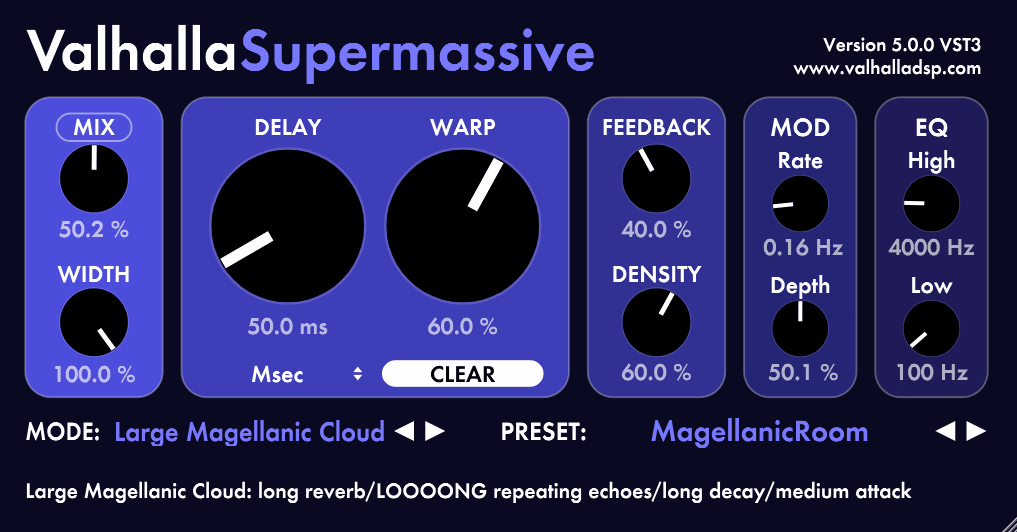
Valhalla has a reputation for building reverbs that punch above their price, and Supermassive is the most extreme version of that. It’s free, covers an enormous range of spatial effects from tight ambience to room-filling washes that take minutes to decay, and has accumulated a following across genres that have almost nothing in common with each other.
That broad appeal is worth examining. Most effects plugins with a devoted following earned it by doing one specific thing exceptionally well. Supermassive earned it by building a character that translates across contexts without feeling generic.
The sonic identity
Supermassive delay is built around delay-based reverb algorithms rather than convolution or traditional feedback networks, and that distinction matters for how it sounds. The reverb doesn’t behave like a room or a physical space. It behaves like something larger and less defined, which is exactly what makes it useful on material where a realistic acoustic environment would feel limiting.
Decay times stretch far beyond what a conventional reverb offers, going from short ambience into multi-second washes and then into territory closer to infinite sustain than reverb in any traditional sense. At the extreme end of the decay control, Supermassive stops being a reverb and becomes a pad generator, sustaining and evolving the input signal in ways that have nothing to do with physical acoustics.
What keeps this from sounding like a novelty is the quality of the tails. The decay is smooth and consistent across the frequency range, and the modulation built into each algorithm adds subtle movement to the reverb tail that stops it feeling static even on very long decay settings.
Here’s what defines the core sound across all modes:
- Smooth, non-physical decay that doesn’t try to replicate any real acoustic environment
- Built-in modulation on every algorithm that adds gentle pitch and time variation to the tails
- Extended decay range that moves from normal reverb territory into infinite sustain
- Wide stereo imaging that spreads naturally without narrow mono buildup in the center
- Low density at short settings that opens into a dense wash as decay increases
Eighteen modes and how to actually use them
Supermassive ships with 18 algorithms, and the range between them is wider than most reverb plugins cover in their entire feature set.
The Gemini and Hydra modes are the most versatile starting points for conventional reverb use. They give you a dense, smooth tail that works on vocals, guitars, and pads without immediately announcing itself as something unusual. If you’re new to Supermassive, these are the right place to start before exploring the more extreme algorithms.
Cassiopeia and Aquarius move into longer, more diffuse territory where the reverb starts to lose its connection to the original transient and become more of an ambient wash. These work particularly well on sustained synth pads and atmospheric textures where you want the reverb to contribute its own character rather than just extending the natural decay of the source.
The Andromeda and Sagittarius modes are where Supermassive gets genuinely unusual. The decay behavior introduces a spatial movement that shifts the perceived position and size of the reverb tail over time. On a long pad or a slow melodic line, that movement creates the impression of a space that’s evolving rather than static.
- Density and size interaction
Density controls how quickly echo density builds in the early part of the tail, and at low values it introduces a distinct pre-echo character where individual repeats are audible before blending into the wash. Size scales the overall dimensions of the algorithm, and the interaction between low density and large size produces a sound particularly useful for cinematic and ambient work where you want space without mud.
At high density and large size simultaneously, Supermassive produces the thick, enveloping wash most people associate with the plugin. That combination works well on material that benefits from being surrounded by reverb rather than just extended by it.
- Modulation depth and rate
Low depth values add warmth and slight instability to the tails that makes them feel more organic. Higher values introduce a pitch movement that becomes a character of its own, particularly on vocal reverb where the shimmer-adjacent effect works well on slower, atmospheric material.
Keep rate slow in almost every mixing context. Fast modulation rates on a long reverb tail create a chorus-like effect in the decay that draws attention to the reverb rather than letting it support the source.
Where it earns its place
- Vocals in ambient, indie, and electronic music
The long smooth tails create a sense of space that fits the material without the reverb feeling like a room you could walk into. The wide stereo imaging gives the reverb a presence in the mix that doesn’t compete with the dry vocal for the center of the field.
- Synthesizer pads and atmospheric textures
Supermassive is genuinely hard to beat at any price point here. The extreme decay settings turn a simple pad into something that fills the frequency spectrum with movement, and the algorithm variety means you can find a mode that matches the character of the source rather than imposing a one-size-fits-all reverb character on everything.
- Cinematic and soundtrack work
The longer algorithm modes produce spatial effects that convolution reverbs struggle to match because they’re not trying to replicate a real space. The sense of scale in Andromeda and Sagittarius specifically is something you’d spend significant money on in a dedicated reverb plugin.
- Drums and percussion in a busy mix
This is where it’s less reliable. The diffuse, non-physical character that makes Supermassive useful on sustained material works against the transient definition that percussion needs in a dense arrangement. Short decay settings help, but there are better choices for drum reverb where accuracy and punch matter more than atmosphere.
Where it stops working
Supermassive is not a transparent or accurate reverb. If you need something that replicates a physical space convincingly, whether that’s a specific room, hall, or plate, this plugin isn’t the right tool. The algorithms create their own spatial character, and that character is distinctive enough to be recognizable once you know what to listen for.
It also struggles on dense, busy mixes where the wide stereo spread and long tails introduce mud rather than space. In a production with a lot of sustained elements already occupying the mid and high frequencies, adding Supermassive on multiple channels raises the noise floor without adding clarity. Restraint is part of using it well.
Pre-delay is limited compared to paid alternatives. For mixing applications where pre-delay is doing important work to separate the reverb from the dry signal, you’ll notice that gap. Running a short delay before Supermassive in your effects chain solves it, but it’s an extra step that more fully-featured reverbs handle internally.
What actually explains the popularity
Free helps, obviously. But free plugins get ignored all the time, and Supermassive hasn’t been. What actually explains the following is that it fills a gap that paid reverbs at similar and higher price points often don’t address directly.
Most reverb plugins optimize for realism and accuracy because those qualities are easy to market. Supermassive optimized for a specific kind of oversized spatial character that happens to be exactly what a large portion of modern music production needs. Ambient, cinematic, modern pop, lo-fi, and atmospheric electronic genres all benefit from reverb that creates size rather than simulates space, and Supermassive does that better than most things at any price.
The 18 algorithms at no cost means genuine variety rather than one reverb character with minor variations. The difference between Gemini and Andromeda is large enough that they function as different tools for different jobs, which gives the plugin a utility that goes well beyond what most free plugins offer.
Valhalla Supermassive runs as a VST, VST2, VST3, AU, and AAX plugin on both Mac and Windows, requires no iLok or online activation, and installs in minutes. Download it, spend time with the Gemini and Andromeda modes specifically, and it’ll become clear quickly why it has the reputation it does.

Hey, I’m Viliam, I started Music Circuit to write about plugins and gear, so you always know what’s new and what’s worth trying. You’ll also find guides and tips here to help you get started, whether you’re picking your first plugin or building out a full studio.