When you purchase through the links on my site, you support the site at no extra cost to you. Here is how it works.
Brainworx has a reputation for building tools that are technically precise without being overcomplicated, and bx_limiter True Peak is a good example of that. It’s a true peak brickwall limiter aimed at mastering and mix bus work, and the core promise is straightforward: clean, accurate limiting with reliable true peak compliance for modern streaming delivery.
Unlike a lot of competitors that pack in eight algorithms and deep modulation routing, Brainworx kept this one focused. You get one well-implemented limiting engine, solid true peak enforcement, and a clean interface that doesn’t get in the way.
What you’re actually working with
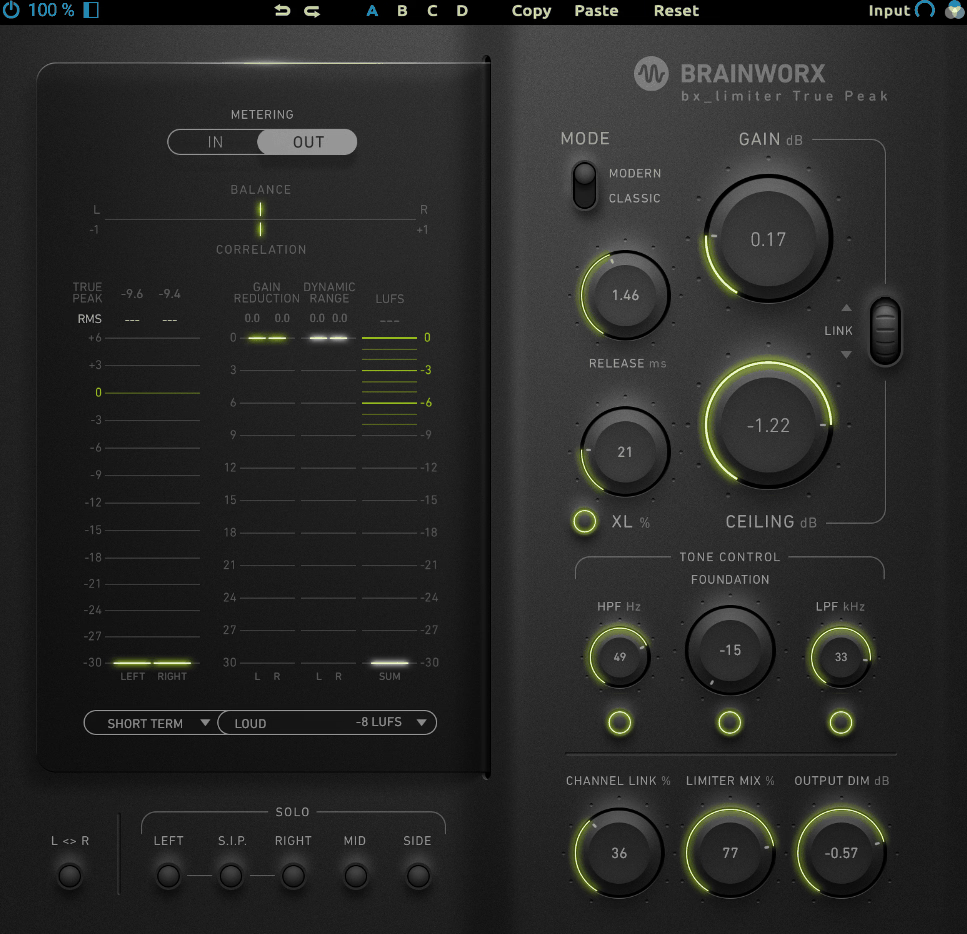
The interface puts everything visible without secondary menus or tabs. The main controls cover input gain, output ceiling, attack, release, and a true peak ceiling control, all laid out in a way that makes the signal flow immediately obvious.
The large gain reduction meter gives you a clear real-time picture of how hard the limiter is working without squinting at a small numerical readout. That kind of visual feedback matters during longer sessions when your ears and eyes are already working hard.
The lookahead control directly affects how transparently the limiter handles fast transients. Shorter lookahead values give you a slightly more colored response, while longer values allow the limiter to anticipate peaks further ahead and handle them more gracefully. I found a lookahead of around 1.5 to 2ms hits a good balance for most material without introducing noticeable latency in a mixing context.
True peak compliance in practice
The true peak ceiling is accurate and consistent. When you set it to -1 dBTP you can trust that your output is actually staying within that ceiling after lossy encoding, which is the whole point of true peak metering in a streaming delivery context.
True peak and sample peak are different measurements, and a limiter that only catches sample peaks can still produce intersample distortion after your file gets encoded to AAC or MP3 for Spotify or Apple Music. bx_limiter True Peak handles this correctly, and I found the readings consistent when cross-referenced against dedicated metering tools.
Here’s what the metering section gives you:
- True peak display with accurate ceiling enforcement at your set value
- Gain reduction meter showing real-time limiting activity with clear visual feedback
- Input and output level metering for monitoring signal levels before and after the limiter
- Integrated and short-term loudness readings for streaming delivery reference
For most streaming delivery, setting the true peak ceiling to -1 dBTP gives you enough headroom to avoid audible distortion after lossy encoding while still landing at a competitive integrated loudness for your target platform.
Where it performs well and where it doesn’t
bx_limiter True Peak performs best on material that is already well-prepared before it hits the limiter. The cleaner and more balanced your mix going in, the better this limiter sounds coming out.
On dense, transient-heavy material like modern pop or hip-hop, it handles limiting cleanly up to around 3 to 4 dB of gain reduction before artifacts start becoming noticeable. Beyond that you’re better off preparing the mix more carefully upstream or running a clip shaper before the limiter rather than pushing this one harder.
On slower, more dynamic material like acoustic, jazz, or orchestral, it genuinely shines. The transparency at moderate gain reduction values is impressive, and I noticed it preserves the dynamic character of the material in a way that feels natural rather than processed.
Here’s where it works best across different use cases:
- Mastering of acoustic and organic genres where transparency is the priority and gain reduction stays modest
- Mix bus limiting where you need clean peak control without significantly affecting the dynamic character of the mix
- Stem limiting where consistent behavior across multiple outputs matters
- Broadcast and podcast delivery where hitting a specific true peak ceiling reliably is the primary requirement
- Electronic music at moderate loudness targets where the mix isn’t pushing the limiter too hard
How it stacks up against Pro-L 2
The most direct comparison is FabFilter Pro-L 2, and it’s worth working through honestly. Pro-L 2 gives you eight algorithms, deeper metering, and more granular control over the limiting behavior, and at $199 it’s a more comprehensive tool overall.
bx_limiter True Peak sits at a lower price point and frequently appears in Plugin Alliance sales and bundle deals that make it even more accessible. If your primary need is clean, accurate true peak limiting without the additional algorithm variety and metering depth of Pro-L 2, it covers that reliably.
I’d say if you find yourself always reaching for Pro-L 2’s Transparent mode and largely ignoring the other algorithms, bx_limiter True Peak covers that same territory competently at a lower cost. The extra $100 or so toward Pro-L 2 makes sense if you actively use multiple algorithms across different genres and sessions.
Pros and cons
Pros:
- Accurate true peak ceiling enforcement that holds up reliably after lossy encoding for streaming delivery
- Clean, transparent limiting on acoustic, jazz, orchestral, and any genre where dynamic preservation matters
- Straightforward interface with no hidden menus, everything visible and immediately accessible
- Frequently discounted through Plugin Alliance sales and bundle deals, making it genuinely good value
Cons:
- Single limiting algorithm means less flexibility across different genres and loudness targets compared to Pro-L 2
- Starts showing artifacts above 3 to 4 dB of gain reduction on dense, transient-heavy material
- Metering is functional but not deep, lacking the full LUFS suite and streaming platform targets you get in more comprehensive tools
Bottom line
bx_limiter True Peak does what it says, and in a market full of limiters that overpromise on transparency, that’s genuinely worth something. The true peak compliance is accurate, the interface is clear, and the workflow is fast once you understand where it performs best.
It runs as a VST, VST3, AU, and AAX plugin on both Mac and Windows, with native Apple Silicon support and a low CPU footprint that makes it practical at the end of a dense plugin chain.
I would recommend it to engineers who want a focused, reliable true peak limiter without paying for features they won’t use, and particularly to anyone working regularly in genres where transparency and dynamic preservation matter more than maximum loudness.

Hey, I’m Viliam, I started Music Circuit to write about plugins and gear, so you always know what’s new and what’s worth trying. You’ll also find guides and tips here to help you get started, whether you’re picking your first plugin or building out a full studio.